
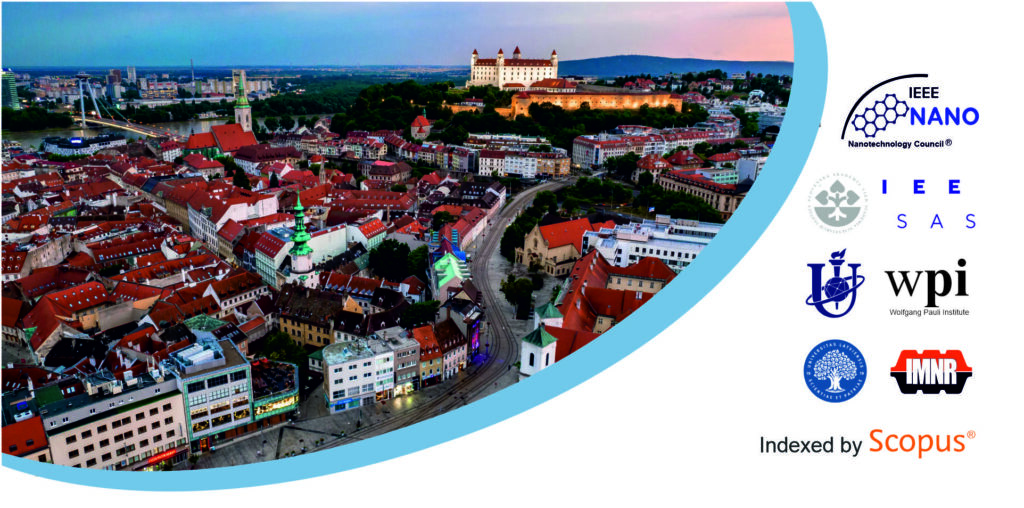
IEEE NAP'25 Conference
Welcome to Bratislava!
Dear Colleagues,
On behalf of the Organizing Committee, it is our honor and pleasure to invite you to the 2025 IEEE 15th International Conference on “Nanomaterials: Applications & Properties” (IEEE NAP-2025), which will be held September 7–12, 2025, at the Crowne Plaza Hotel in the beautiful city of Bratislava, Slovakia.
This conference is jointly organized by the IEEE Nanotechnology Council and the Institute of Electrical Engineering at the Slovak Academy of Sciences, with technical contributions from Sumy State University, the Wolfgang Pauli Institute (WPI) Vienna, the University of Latvia, and the National Research and Development Institute for Non-ferrous and Rare Metals (Romania).
IEEE NAP conference continues its tradition of showcasing cutting-edge advancements in nanoscale materials, with a focus on interdisciplinary research to unlock their unique physical and chemical properties for real-world applications. As a rapidly expanding field, nanoscience and nanotechnology are driving transformative discoveries in areas such as quantum information science, low-power electronics, supercomputing, advanced medical therapies, renewable energy, and clean-air technologies.
This year our conference will also feature a special Symposium titled: “The MXene Frontier: Transformative Nanomaterials Shaping the Future.” MXenes, a revolutionary class of two-dimensional nanomaterials, are attracting significant attention for their exceptional versatility, combining metallic conductivity, hydrophilicity, and tunable surface chemistry, with applications spanning diverse disciplines.
IEEE NAP Conference serves as a premier platform for scientists, engineers, educators, and innovators worldwide to exchange ideas and collaborate on the future of nanoscience. Attendees from academia, industry, and beyond — including chemists, physicists, materials scientists, engineers, entrepreneurs, Ph.D. students, and early-career professionals — are all warmly invited to participate.
As with previous conferences, all submitted manuscripts (minimum four printed pages) will undergo a rigorous peer-review process. High-quality papers presenting original, unpublished research on conference topics will be recommended for publication in the IEEE Xplore Digital Library, indexed by Scopus (subject to final IEEE approval).
We look forward to welcoming you to Bratislava, a city steeped in history and culture, for an inspiring week of scientific exploration, collaboration, and innovation.
Join us at IEEE NAP-2025 as we shape the future of nanoscience together!
With warm regards,
The IEEE NAP-2025 Organizing Committee.
Organizing Committee
Organizing Committee of the IEEE NAP-2025 Conference
| Valentine Novosad | Argonne National Laboratory (USA), General Chair |
| Vladimír Cambel | Institute of Electrical Engineering, Slovak Academy of Sciences (Slovakia), General Co-Chair & Local Organizing Committee Chair |
| Maksym Pogorielov | University of Latvia (Latvia), Sumy State University (Ukraine), General Co-Chair |
| Alexander Pogrebnjak | Sumy State University (Ukraine), Slovak University of Technology in Bratislava (Slovakia), General Co-Chair |
| Roxana Piticescu | National Research and Development Institute for Non-ferrous and Rare Metals (Romania), General Co-Chair |
| Yurii Shabelnyk | Sumy State University (Ukraine), Secretary |
| Conference Program Committee: | |
| Goran Karapetrov | Drexel University (USA), Chair |
Andrii Chumak | WPI c/o University of Vienna (Austria) |
Milan Ťapajna | Institute of Electrical Engineering, Slovak Academy of Sciences (Slovakia) |
| Vierka Skakalová | Institute of Electrical Engineering, Slovak Academy of Sciences (Slovakia) |
| Igor Iatsunskyi | Adam Mickiewicz University (Poland) |
| Vladimír Bužek | Institute of Physics Slovak Academy of Sciences (Slovakia) |
| Oleksandr Prokopenko | Taras Shevchenko National University of Kyiv (Ukraine), Publication Chair |
| Jozef Fabian | Institute of Electrical Engineering, Slovak Academy of Sciences (Slovakia), Finance Chair |
| Miroslava Blazyova | Institute of Electrical Engineering, Slovak Academy of Sciences (Slovakia), Finance Co-Chair |
| Andrii Chumak | WPI c/o University of Vienna (Austria), Awards & Grants Chair |
| Marian Precner | Institute of Electrical Engineering, Slovak Academy of Sciences (Slovakia), IT & Technical Support Chair |
| Matteo Bruno Lodi | University of Cagliari (Italy), YP & Students Activities Chair |
| Kateryna Diedkova | Sumy State University (Ukraine), University of Latvia (Latvia), YP Student Activities Co-Chair |
International Scientific Advisory Board
| Valentine Novosad | Argonne National Laboratory (USA), Chair |
| Maksym Pogorielov | University of Latvia & Sumy State University, Co-Chair |
| André Anders | Leibniz Institute of Surface Engineering (Germany) |
| Aleksandra Baron-Wiechec | United Kingdom Atomic Energy Authority, Oxford (United Kingdom) |
| Oksana Chubykalo-Fesenko | CSIC – Instituto de Ciencia de Materiales de Madrid (Spain) |
| Nicola Pinna | Humboldt University of Berlin (Germany) |
| Kremena Makasheva | French National Center for Scientific Research – CNRS (France) |
| Denise Erb | Institute of Ion Beam Physics and Materials Research, HZDR (Germany) |
| Ali Erdemir | Texas A&M University (USA) |
| Yury Gogotsi | Drexel University (USA) |
| Laura H. Greene | Florida State University & National High Magnetic Field Laboratory – Tallahassee (USA) |
| Vladimir Tsukruk | Georgia Institute of Technology (USA) |
| James E. Morris | Portland State University (USA) |
| Vierka Skakalová | Institute of Electrical Engineering Slovak Academy of Sciences (Slovakia) |
| Oleksiy Kolezhuk | Taras Shevchenko National University of Kyiv (Ukraine) |
| Vladimir Komanicky | Pavol Jozef Safarik University (Slovakia) |
| Oleg Lupan | Technical University of Moldova (Moldova) |
| Yuko Ichiyanagi | Yokohama National University (Japan) |
| Tetsuya Nakamura | Tohoku University (Japan) |
| Alexander Pogrebnjak | Sumy State University (Ukraine) |
| Marek Przybylski | AGH University of Science and Technology (Poland) |
| Sara Majetich | Carnegie Mellon University (USA) |
| Tijana Rajh | Arizona State University (USA) |
| Montserrat Rivas | University of Oviedo (Spain) |
| Wojciech Simka | Silesian University of Technology (Poland) |
| Modris Greitāns | Latvian Academy of Sciences, Institute of Electronics and Computer Sciences (Latvia) |
| Oksana Sulaieva | Medical Laboratory CSD (Ukraine) |
| Tetiana Tatarchuk | Vasyl Stefanyk Precarpathian National University (Ukraine) |
| Oleksandr Tovstolytkin | Institute of Magnetism NAS of Ukraine (Ukraine) |
| Nicoletta Ditaranto | University of Bari Aldo Moro (Italy) |
| Fedir Sizov | V.E. Lashkaryov Institute of Semiconductor Physics NAS of Ukraine (Ukraine) |
Local Organizing Committee
| Vladimír Cambel | Institute of Electrical Engineering, Slovak Academy of Sciences (Slovakia), General Co-Chair & Local Organizing Committee Chair |
| Milan Ťapajna* | Institute of Electrical Engineering, Slovak Academy of Sciences (Slovakia) |
| Vladimír Bužek* | Institute of Physics Slovak Academy of Sciences (Slovakia) |
| Vierka Skakalová* | Institute of Electrical Engineering, Slovak Academy of Sciences (Slovakia) |
| Jozef Fabian | Institute of Electrical Engineering, Slovak Academy of Sciences (Slovakia), Finance & Exhibits Chair |
| Miroslava Blazyova | Institute of Electrical Engineering, Slovak Academy of Sciences (Slovakia), Finance & Exhibits Co-Chair |
| Marian Precner | Institute of Electrical Engineering, Slovak Academy of Sciences (Slovakia), IT & Technical Support Chair |
*) Conference Program Committee
Partners & Sponsors
IEEE NAP Partners
Wolfgang Pauli Institute (WPI) Vienna

The WPI is a “network of excellence”, interdisciplinary in STEM fields like mathematics, including statistics & scientific computing & machine learning, informatics, computational sciences, physics, chemistry, material science, biology, medicine, and social sciences. Full members bear an excellence grant like ERC, START/Wittgenstein, etc. Created and managed by scientists for scientists as a private non-profit association, the WPI is a synergetic partner of public universities in Vienna and all of Austria. The WPI hosts the International Research Laboratory “Institut CNRS Pauli” and similar cooperations with INRIA and INSERM.
The WPI has been actively supporting Ukraine and Ukrainian scientists since the beginning of Russia’s invasion of Ukraine. The 3rd round of Pauli Ukraine scholarships (March 2024) provided support for 20 Ukrainian scientists who (have to) stay in their country.
Murata Manufacturing Co., Ltd.

Murata Manufacturing Co., Ltd. is a global comprehensive electronic components manufacturer that develops, produces, and sells electronic components based on ceramics. By leveraging our independently developed and accumulated expertise in materials development, process development, product design, production technology, as well as supporting technologies such as software, analysis, and evaluation, we create unique products and contribute to the advancement of the electronics society.
Angstrom Engineering Inc.

Angstrom Engineering is a leading international supplier of thin film deposition equipment. All our products are designed and assembled on-site by our engineers, technologists, and technicians. From cutting-edge labs to renowned research facilities worldwide, our tools empower innovation. We provide ready access to our engineering team, so you can speak directly to someone with many years of experience if you need help identifying the correct system for your lab, have any questions or need support. Ensuring a seamless experience from selection to post-purchase support.
U.S. - Ukraine Foundation
BioUkraine is the U.S.–Ukraine Foundation’s initiative aimed at supporting the advancement of biotechnology in Ukraine by encouraging innovative approaches by students, researchers, entrepreneurs, and small- and medium-sized businesses. The project, made possible through generous financial support of donors, seeks to expand educational and economic opportunities for the people of Ukraine, equipping them with the tools, training, and connections they need to be on the cutting edge of meaningful discovery. We believe in unleashing the potential of scientists in Ukraine to empower them in fighting global diseases, feeding the world’s growing population, and protecting our planet.
INNOMXENE Co., Ltd.

Since its establishment in 2021, INNOMXENE Co., Ltd. is a company that has been developing and mass-producing MXene source material, an advanced two-dimensional nanomaterial, through independent resource recycling, nano technology, and development of utilization technology.
INNOMXENE has developed technology to use low-cost raw materials such as recycling as raw materials, and has developed high-purity/single-layer MXene manufacturing technology while reducing material costs. The MXene material created in this way is receiving excellent reviews in the world research markets not only for its price but also for its high characteristics. The proprietary technology created through these efforts was selected as one of the “Top 10 Nanotechnologies of 2023” organized by the Korean government in 2023, bearing small fruit as a technology recognized by everyone.
Danaher Cryogenics, Ltd.
Danaher Cryogenics is a trusted leader in advanced cryogenic solutions, serving cutting-edge research in quantum technology, materials science, superconductivity, and low-temperature physics. Their systems support some of the world’s most sensitive experiments, enabling breakthroughs in nanoscience, quantum sensing, and cryoelectronics. Known for its proven record of precision engineering and robust performance, Danaher Cryogenics provides closed-cycle cryostats, dilution refrigerators, and custom cryogenic platforms tailored to the demanding needs of academic and industrial R&D.
QZabre AG
QZabre AG is a fast-growing leader in nanoscale magnetometry and quantum sensing, specializing in Nitrogen-Vacancy (NV) center technology. We offer commercial diamond tips with single or ensemble NV centers, turnkey scanning NV microscopes for both room and cryogenic temperatures, confocal microscopes for diamond color centers, and educational kits for university programs. Our multidisciplinary team of physicists, engineers, and developers is dedicated to delivering innovative products and services that surpass the expectations of the scientific community.
ATLANT 3D
ATLANT 3D is a deep-tech platform company pioneering Direct Atomic Layer Processing (DALP®), a patented technology that enables programmable atomic-scale manufacturing. Designed for maximum precision, flexibility, and speed, the platform accelerates innovation across semiconductors, advanced materials, aerospace, energy, defense, and more. From advanced packaging and microfluidics to photonics, MEMS, and next-generation sensors. ATLANT 3D empowers industrial and scientific teams to prototype, iterate, and scale breakthrough devices, moving from lab to fab faster than ever before.
IEEE NAP Sponsors

The IEEE Nanotechnology Council focuses on the advancement and coordination of work in the field of Nanotechnology. The Council is a multi-disciplinary group supporting the theory, design, and development of nanotechnology and its scientific, engineering, and industrial applications. The Council sponsors well-recognized, international conferences and publications. Through the Council’s sponsored activities, participants have the opportunity to publish and collaborate on research, network with colleagues, stay current on news and events, develop standards, and participate in educational activities. There are no membership requirements to join and participation in this Technical Council is free for current IEEE members!
Institute of Electrical Engineering Slovak Academy of Sciences

Institute of Electrical Engineering Slovak Academy of Sciences (IEE SAS) is a scientific institution founded in 1953. Research areas of the institute cover disciplines of electronic and electrical engineering and solid-state physics supported by extensive material research. Our researchers implement international projects supported by European Commission (H2020, ERDF), and national projects supported by APVV and VEGA agencies.
Research activities of IEE SAS are currently focused on Physics and technology at nanoscale, III-V compound semiconductors, Microelectronic sensors and detectors, Applied superconductivity
Sumy State University

Sumy State University (SumDU) is a higher educational institution in Sumy, Ukraine. It enrolls over 12 000 students pursuing pre-undergraduate, undergraduate, specialist, and master degrees in 57 majors and 25 fields. About 1 300 foreign students represent almost 50 countries worldwide. Today, SumDU is a leading university of a classical type with the III-IV accreditation level in the region.
SumDU enters the TOP-group (3%) of leading universities of the world and is classified as a university with high research intensity according to the international ranking of higher education institutions QS World University Rankings. According to these rankings, SumDU enters the group of leading Ukrainian universities. SumDU also ranked 101-150 among the fastest-rising young stars of the higher education world by the QS.
University of Latvia

The University of Latvia stands as a premier educational and research institution in Latvia, holding a distinguished position among the Baltic states. Its mission is to contribute significantly to global scientific advancement, higher education, and the transfer of knowledge, technology, and innovation. Renowned for its scientific excellence on an international scale, the University of Latvia cultivates an interdisciplinary, innovative, and open environment conducive to exceptional work and study. The University’s activities are fundamental to the sustainable development and economic transformation of the Republic of Latvia.
National Research & Development Institute for Non-ferrous and Rare Metals - IMNR

Founded in 1966, IMNR is a strategic institute in the field of non-ferrous metals metallurgy research and applications, focused on responding with the highest quality services to scientists and business needs. Innovation and know-how transfer are the core of research activity in IMNR. Starting from 2004, IMNR became a national R&D institute organized in three laboratories according to the scientific research directions developed by the institute: i) Eco-technologies and Environmental Protection Laboratory; ii) Nanostructured Materials Laboratory, and iii) Advanced Materials.
Endorsed by
Slovak Academy of Sciences
The Slovak Academy of Sciences (SAS) is the main scientific and research institution in Slovakia fostering basic and strategic basic research.
Its primary mission is to acquire new knowledge of nature, society, and technology, specifically targeted at ensuring scientific basis for the advancement in Slovakia. It comprises 58 scientific institutes and 13 ancillary institutions. The SAV edits 44 scientific and scholarly journals and 100–120 monographs per annum. Moreover, 41 scientific and scholarly societies, which associate scientists and scholars from various disciplines, are affiliated with SAV.
Ministry of Education and Science of Ukraine

The Ministry of Education and Science of Ukraine is the central body of executive power, whose activity is directed and coordinated by the Cabinet of Ministers of Ukraine. MES is part of the executive power and is the main body in the system of central executive authorities to ensure the formation and implementation of public policies in the areas of education and science, scientific, technology and innovation, information, formation and use of national electronic information resources, creating conditions for the development of the information society, as well as in the implementation of state supervision (control) over the activities of educational institutions regardless of their subordination and form of ownership.